Elena Stoin’s folk musical dialects
01 April, 2015 – 01 April, 2017
Author: Prof. Goritsa Naidenova, Music Department
In 2015, we mark Elena Stoin’s 100th anniversary. Her figure and professional activities are indelibly related to the establishing of the Folk Music Department, Institute of Art Studies, BAS, successor to which is now the Music Department of the Institute. Following the top-priority for the Institute in the initial decades of its existence line of intensive fieldwork and regional studying of traditional music, Elena Stoin left an enormous storage of recordings (over 5,000), which forms a substantial part of the collection of the Institute’s Archive of Folk Music. She was the researcher, who had crowned years of work of generations of folklorists with the formulated by her theoretical model of Bulgarian musical dialectology, comprehensively presented in her study Folk Musical Dialects in Bulgaria. The publishing of Elena Stoin’s work had yet another important effect: it became a theoretical basis, through which musical dialectology was incorporated in folk music teaching programmes at secondary and higher education institutions. Back in 1981, of course, there were just two options for presenting music in printed publication: a verbal description/analysis and notated tunes. The audio representation of different styles in the educational process is a matter of a future solution.
In the days, when Elena Stoin worked on her book, folk music was presented in the public domain almost entirely through the stage and the media, which led to the establishing of a sound picture different from the old rural music. That was also a time, when parallel lines of ‘preservation’ and respectively, of defining of the local folk styles were undertaken by the companies performing arranged folk pieces. And respectively, training of their performers of such styles. With the ever increasing and accessible options for sound recording for the needs of coaching, as well as for fostering local and general patriotism, various compilations of recordings began to be made ‘by districts’. In the 1990s, the National Radio also released a set of two CDs containing recordings from its archive. These audio illustrations, as a rule, have been selected and dressed up so that to be acceptable to the ear of modern men, to point comfortably at those specifics of the folklore, which have been decided to ought to differentiate one local style from another. These would on more than one occasion follow and feed the ideas of that aesthetical, social and ideological environment, which was quite aptly defined as ‘academic folk singing’ by a folk singing coacher in her recently defended thesis. Everything stated above suggests just some of the theoretical issues that could be commented in the textual theoretical part of the proposed project.
The real picture from which Elena Stoin drew the folk musical dialects is a picture of the old traditional rural music. The records, underlying her work on this picture, are kept only in our archive. The best way to mark the 100th anniversary since her research work is to use the options of modern technologies and to link Elena Stoin’s word to the music it really refers to. Such an edition would have both research and promotional (when it comes to the richness of the archive) result oriented towards educational practices and would hopefully be a worthy tribute to her work.
Central to the project will be the preparation of a CD with archival recordings made by Elena Stoin for the sake of her study (or quoted in it). It will contain a textual part, which would present their ‘Ids’ along with the theoretical reasoning on the selection of the recordings, trying to trace out their own history and linking them to deciphering or fieldwork notes, placing them in the context of the activity of the Institute as a whole and of Elena Stoin’s theoretical work.
The work on the project requires: 1) Digitising of a substantial number of tapes, their description and playing them back; 2) Formulating an adequate and precise concept of selection of the recordings depending on their quality, representativeness of the respective region (according to Elena Stoin) and still, on the permanent necessities of composing a CD as a whole; 3) A written statement of the argumentation of the selection of the recordings, i.e. composition of the analytical text; 4) Selection of the illustrative documents on paper; 5) Their digitisation and preparation for publishing; 6) Postproduction of the sound recordings; 7) Final layout of the edition and possibly, 8) Public presentation of the edition.
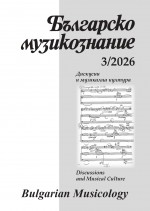
Indispensable members of the team for now are: Diana Danova, Maria Kumichin, Alex Nushev and I. We hope to succeed in publishing our study as a special edition of Bulgarian Musicology journal plus a CD.